
The History of Española Way, Miami Beach: Why It’s Still the Heart of South Beach
If there is one street in Miami Beach that tells a story, and keeps writing it every night, it’s Española Way. Tucked just one block south of 15th Street, between Collins and Washington avenues, this pedestrian enclave in the heart of South Beach is far more than a dining destination: it’s a portal to another era, another continent, and another way of experiencing the city.
At Vida & Estilo Hospitality Group, we’ve been part of this one-of-a-kind setting for years, curating the street’s soul since 1997 with our signature spots: Oh! Mexico, Havana 1957, Mercato della Pescheria, and Paperfish Sushi .
Recently, in partnership with the Española Way Association, V&E unveiled a new Don Quijote sculpture on Española Way – a reimagining of a figure who has always stood for idealism, courage, and the belief that some things are worth fighting for, even when the path is uncertain. Not just a landmark. A statement.
So with the energy surrounding the unveiling of this new icon, there’s no better moment to tell, or retell, the story of one of Miami’s most special places.
Española Way: The Early Days of a Bold Vision
It all began in the early 1920s, when architect Robert Taylor and developers N.B.T. Roney and William Whitman conceived something unusual for a city that was barely finding its footing: a bohemian Mediterranean enclave in the heart of South Beach.
The inspiration came from Las Ramblas in Barcelona, the French Riviera in Cannes, the coastal promenades of Italy. With that spirit, Española Way was born as a “Historic Spanish Village,” complete with Moorish-Spanish architecture: arched doorways, wrought-iron balconies, stucco walls, and terracotta rooftops.
Within just a few years, the street became the social hub of Miami Beach’s well-heeled set. Restaurants, bars, and clubs buzzed deep into the night. It was glamour in its purest form.
Glitz & Shadows: The Capone Era and the Golden Years
Like every great story, Española Way’s history has a darker side, and that’s exactly what makes it so compelling.
The wealth and geographic isolation of Miami Beach made it particularly attractive to organized crime in the 1920s and ’30s. Al Capone himself spent his winters in South Beach, frequenting the Clay Hotel – still standing on Española Way today – and other establishments along the strip for gambling and socializing.
Behind the façade of sophistication lay a city negotiating with power in all its forms. That tension between splendor and shadow gives Española Way a historical depth that few American streets can match.
Decline & Resurrection
By the mid-20th century, Española Way had begun to slide into neglect. Like much of Miami Beach at the time, the street lost its shine and its energy. Buildings deteriorated. The glamour gave way to disrepair.
But great stories have second acts.
In the 1980s, thanks to the ambition and hard work of landlords and preservationists like Linda Polansky and Barbara Capitman, a key figure in saving Miami Beach’s Art Deco heritage, Española Way began a remarkable recovery. Buildings were restored. Life returned.
With that revival came cultural recognition: the show Miami Vice used Española Way as a filming location across multiple episodes, including the very first and the very last. The street became a visual symbol of a city reinventing itself.
Española Way Today: A Pedestrian Street, Alive and Evolving
In May 2017, the City of Miami Beach converted Española Way into a fully pedestrian thoroughfare. That transformation was a turning point.
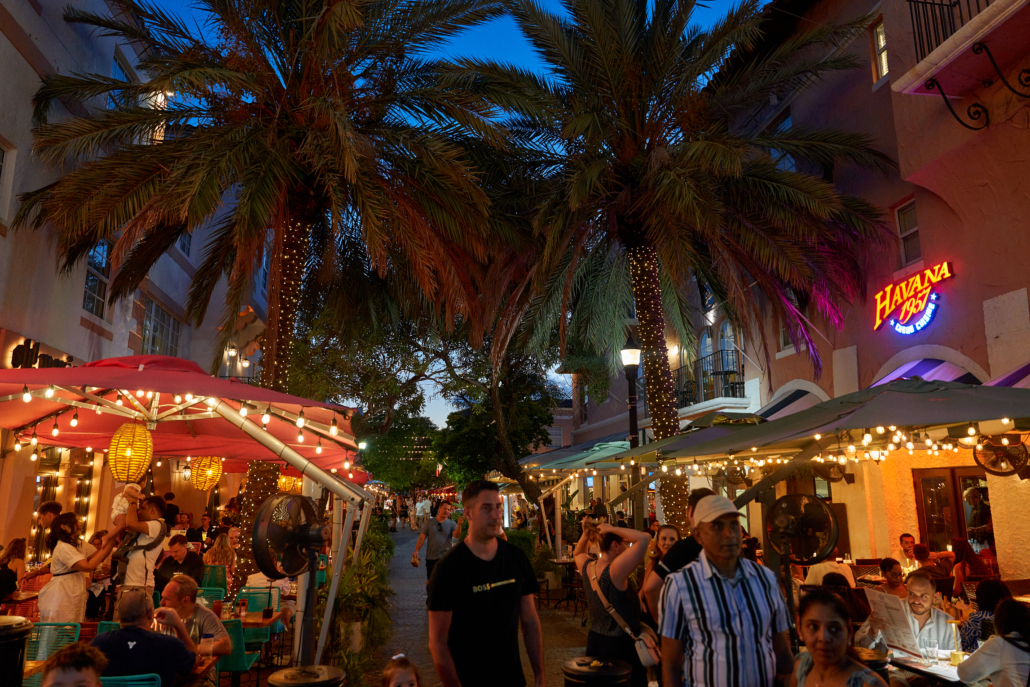
Today, Española Way offers one of South Beach’s most singular experiences: a car-free street, warmly lit at night, lined with peach and terracotta façades, outdoor dining terraces, art galleries, boutique shops, yoga studios, and bars that hum until late. The atmosphere is unmistakably European but warmed by the unmistakable heat of the Caribbean and Miami.
It’s the place where locals mix with visitors. Where salsa plays on Sunday evenings and yoga happens at sunset. Where a night can start with an aperitivo and end well past midnight.
Why Española Way Matters — and Always Will
At V&E, we believe the best restaurants don’t exist in a vacuum. They are part of a community, a neighborhood, a history. Española Way isn’t just an address; it’s a character, a context, a legacy.
When you sit on the terrace at Mercato della Pescheria or order a mojito at Havana 1957, you’re not just choosing what to eat. You’re choosing to be part of a street that has spent over a century being the stage where Miami Beach meets itself.
That’s the kind of place we want to be part of. And the kind of story we want to keep telling.
Visit Us on Española Way
Havana 1957 | 405 Española Way, Miami Beach
Mercato della Pescheria | 412 Española Way, Miami Beach
Paperfish Sushi Bar | 432 Española Way, Miami Beach
Oh! México | 1440 Washington Ave, Miami Beach